


Written by
Kosta Nicolaou
Director, Skefto
Fact-checked
Ask most organisations what they have to comply with and you’ll get a policy folder, a few calendar reminders and one person who “just knows”. That works until the person leaves, or an auditor asks for evidence. A compliance register puts it all in one place: every obligation, where it comes from, who owns it and whether you’re meeting it.
I built this template for Australian organisations. It’s free, it’s in Excel, and you don’t need to give us your email.
Key takeaways
- Free Excel download, no email needed. It has a 50-row register, eight filled-in Australian examples and a summary tab for your executive report.
- Every obligation has a source, a regulator, one owner, the evidence and where it’s kept, a status and a review date. Overdue dates turn red.
- A “Changes to watch” column keeps it current. The examples include real recent changes, like Payday Super from 1 July 2026.
- Built for whole-of-organisation compliance (safety, privacy, employment, governance), not just one standard.
Download the template
The file has four tabs:
- How to use. Seven short steps.
- Compliance register. 50 numbered rows with dropdowns, filters and red flags for anything overdue.
- Examples. Eight worked obligations from Australian law, each checked on the regulator’s own website.
- Summary. How many obligations are compliant, partly compliant, not compliant or not assessed, plus overdue due dates and reviews.
It also works in Google Sheets. Upload the file to Google Drive and open it with Sheets.
What each column is for
I kept the columns an auditor, a regulator or your board will actually ask about.
| Column | Why it’s there |
|---|---|
| Obligation | What you must do, in plain English. “Notify the regulator immediately after a serious injury” is clearer than a section number. |
| Source | The law and section, licence, standard, contract or policy it comes from. |
| Regulator | Who enforces it. Useful when you need to check a change or call someone. |
| Type | Legislation, regulation, licence, standard, contract or internal policy. |
| Obligation owner | One person or role who is accountable. A team can’t own an obligation. |
| How we comply | The controls you rely on: a procedure, a system setting, training. |
| Evidence and where it’s kept | What you’d show an auditor, and where to find it. |
| Frequency and next due date | Ongoing, each payday, quarterly, on event and so on. Past due dates turn red. |
| Compliance status | Compliant, partly compliant, not compliant or not assessed. |
| Consequence of a breach | Low to severe, so you know where to look first. |
| Last reviewed and next review | When someone last checked it. Overdue reviews turn red. |
| Changes to watch | New or proposed changes, so the register doesn’t go stale. |
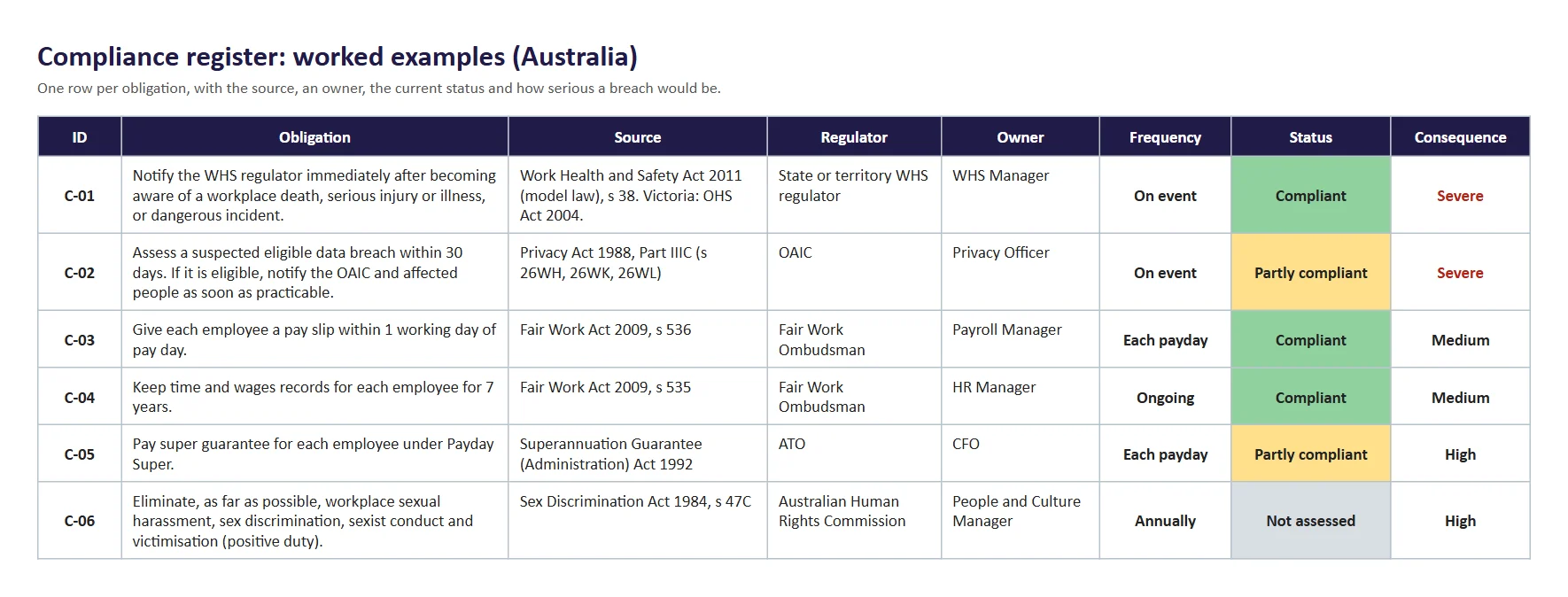
Eight worked examples from Australian law
These are the examples in the template. I read each one on the regulator’s own website on 17 November 2026. Check that each applies to you before you copy it, and set the status from your own evidence, not mine.
| Obligation | Source | Regulator |
|---|---|---|
| Notify the WHS regulator immediately after a workplace death, serious injury or illness, or dangerous incident | Work Health and Safety Act 2011 (model law), s 38. Victoria has its own OHS Act 2004. | Your state or territory WHS regulator |
| Assess a suspected data breach within 30 days, and notify the OAIC and affected people as soon as practicable if it’s eligible | Privacy Act 1988, Part IIIC | OAIC |
| Give pay slips within 1 working day of pay day | Fair Work Act 2009, s 536 | Fair Work Ombudsman |
| Keep time and wages records for 7 years | Fair Work Act 2009, s 535 | Fair Work Ombudsman |
| Pay super guarantee under Payday Super | Superannuation Guarantee (Administration) Act 1992 | ATO |
| Eliminate, as far as possible, workplace sexual harassment, sex discrimination, sexist conduct and victimisation (the positive duty) | Sex Discrimination Act 1984, s 47C | Australian Human Rights Commission |
| Prepare an annual Modern Slavery Statement if consolidated revenue is at least $100 million | Modern Slavery Act 2018 | Attorney-General’s Department |
| Review the register and report to the executive every quarter | Your own compliance policy | Internal |
The data breach rule only covers organisations under the Privacy Act. That includes Australian Government agencies and businesses and not-for-profits with an annual turnover of more than $3 million, plus some smaller ones such as private health service providers.
Keeping the register current
A register is only as good as its last review. Laws change more often than most people expect, and three recent changes show why the “Changes to watch” column matters:
- Payday Super. From 1 July 2026, employers pay super guarantee under Payday Super instead of quarterly. If your register still says “quarterly”, it’s out of date.
- WHS incident notification. In December 2025, Safe Work Australia published amendments to the model WHS Act that widen what has to be notified, including violent incidents and worker absences of 15 or more calendar days. They only become law once each state or territory adopts them, so record the change now and update the obligation when your jurisdiction acts.
- Modern slavery. The 2023 statutory review recommended lowering the reporting threshold from $100 million to $50 million and adding penalties. It isn’t law yet, but if you’re between those two numbers, it belongs in the register.
A simple routine works for most organisations: owners review their own rows when something changes, and the compliance lead reviews the whole register every quarter.
How to build your register in five steps
- List where obligations come from. Start with the laws for your industry, then add licence conditions, standards you’ve committed to (for example ISO 37301 or ISO 27001), key contracts and your own policies.
- Write each one as an action. One obligation per row, in plain English, with the section in the “Source” column.
- Give every row an owner. Usually the manager closest to the work, not the compliance team.
- Record the evidence. For each obligation, ask: “If the regulator asked tomorrow, what would we show them?” Write that down, with where it’s kept.
- Set the status honestly, then review it. “Not assessed” is a perfectly good status. A green row with no evidence behind it isn’t.
Compliance register vs risk register
They work together but answer different questions. A compliance register asks “what must we do, and are we doing it?” A risk register asks “what could go wrong, and how bad would it be?”
When a compliance obligation is at risk, for example a deadline you might miss, add it to the risk register too, and link the two by ID.
When a spreadsheet stops working
A spreadsheet is a good way to start. It starts to hurt when:
- obligations still list owners who left months ago
- nobody sends the reminders, so due dates pass quietly
- the evidence is spread across inboxes and shared drives
- the board report means copying the summary into slides every quarter
That’s what Skefto’s compliance management software is for. The same register becomes a shared system. Owners get reminders before due dates and reviews, evidence sits with the obligation it supports, and dashboards show the current position without any copying. It’s aligned with ISO 37301 and built for councils, government, education, care services and regulated industries across Australia.
Frequently asked questions
What is a compliance register?
A list of every obligation your organisation has to meet, with the source, an owner, how you comply, the evidence and the current status. It’s sometimes called a compliance obligations register or a legal register.
What should a compliance register include?
At minimum: the obligation, its source, the owner, how you comply, the evidence, the status and a review date. This template adds the regulator, the consequence of a breach, due dates and a column for changes to watch.
What are the key areas of compliance?
There’s no official list. For most Australian organisations, the main areas are work health and safety, privacy and data, employment and pay, corporate governance and financial reporting, and the rules for your own industry, such as aged care, education or local government.
Is a legal register the same as a compliance register?
Mostly. A legal register usually lists only laws and regulations, often for ISO 14001 or ISO 45001. A compliance register also covers licences, standards, contracts and internal policies.
How often should a compliance register be reviewed?
There’s no single rule. A common approach is a full review every quarter, plus an update whenever a law, licence or contract changes, or after an incident or audit finding.
Is there a free compliance register template in Excel?
Yes. The Excel template on this page is free with no email form. It includes dropdowns, overdue alerts, a summary tab and eight Australian examples.
Outgrown the spreadsheet?
Skefto runs the same register with owners, reminders, evidence and live dashboards, so nothing depends on one person remembering.
Sources
- OAIC, Part 4: oaic.gov.au/privacy/privacy-guidance-for-organisations-and-government-agencies/preventing-preparing-for-and-responding-to-data-breaches/data-breach-preparation-and-response/part-4-notifiable-data-breach-ndb-scheme
- Safe Work Australia, incident notification: safeworkaustralia.gov.au/safety-topic/managing-health-and-safety/incident-notification
- Fair Work Ombudsman, pay slips: fairwork.gov.au/pay-and-wages/paying-wages/pay-slips
- Fair Work Ombudsman, record-keeping: fairwork.gov.au/pay-and-wages/paying-wages/record-keeping
- Australian Taxation Office, Payday Super for employers: ato.gov.au/businesses-and-organisations/super-for-employers/payday-super
- Australian Human Rights Commission, the positive duty: humanrights.gov.au/positive-duty
- Attorney-General’s Department, Modern Slavery Act: ag.gov.au/crime/modern-slavery/modern-slavery-act
Checked on each regulator’s website on 17 November 2026. This page is general information, not legal advice.