
What is GRC? The Complete Guide to Governance, Risk and Compliance in Australia

What is GRC-Complete Guide to Governance, Risk and Compliance 2026

Governance, risk, and compliance (GRC) is now a commercial necessity for Australian organisations. As regulatory expectations intensify and cyber incidents reported to the OAIC continue to rise, leaders can no longer rely on siloed spreadsheets or reactive audit preparation.

Australia’s regulatory landscape has shifted rapidly. APRA CPS 230 commenced on 1 July 2025, the Aged Care Act 2024 has been in force since 1 November 2025, and the NDIS Quality and Safeguards Commission continues to strengthen its enforcement posture. In this environment, traditional approaches to governance, risk and compliance cannot keep pace.

This guide is written for Australian risk leaders, compliance officers, executives, and board members across local government, state agencies, aged care, and NDIS services. You will learn what GRC means, the three pillars that underpin an effective GRC framework, the key Australian obligations shaping compliance, and how to implement a practical program supported by the right software.

I have spent more than twenty years in public sector risk management and contributed to ISO 22336 on organisational resilience. My experience has taught me that GRC is not a tick-box exercise. It is the bedrock of resilience, accountability, and public trust.
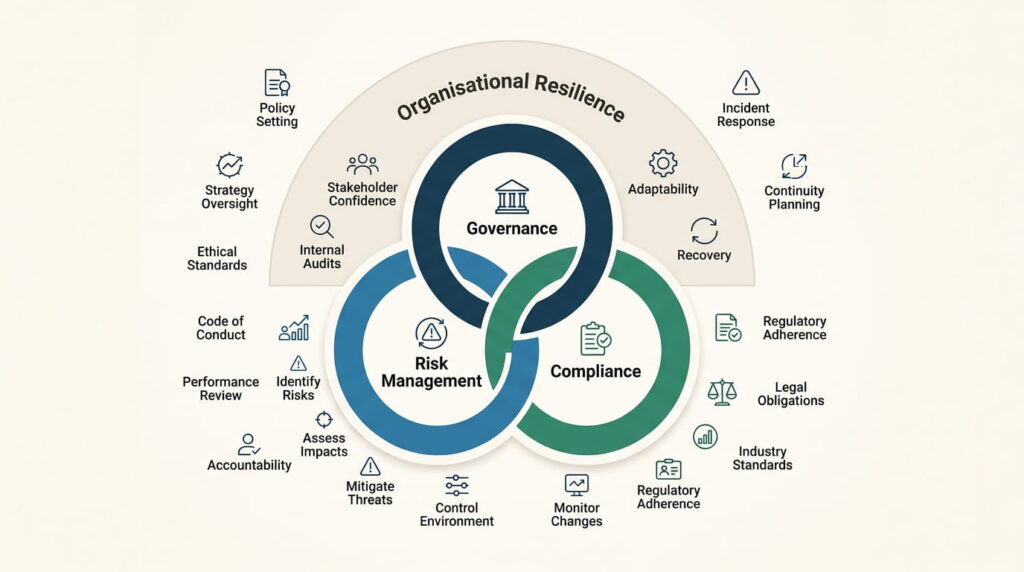
Diagram-showing-how-Governance-Risk-Management-and-Compliance-integrate-to-form-a-unified-GRC-framework

Key Takeaways:

  • GRC stands for Governance, Risk, and Compliance, an integrated discipline rather than three separate functions.
  • An effective GRC framework helps Australian organisations meet mandatory obligations under Ministerial Standing Directions, APRA CPS 230, the Aged Care Act 2024, NDIS Practice Standards, and the Privacy Act 1988.
  • A best practice GRC framework is aligned to Australian and International Standards including AS/ISO 31000, AS/ISO 22336, AS/ISO 37000 and AS/ISO 37301.
  • The OCEG GRC Capability Model (Learn, Align, Perform, Review) provides the global reference architecture for high-performing organisations.
  • High GRC maturity drives faster, evidence-based decisions, continuous audit readiness, and stronger board confidence.

What Does GRC Stand For? (GRC Meaning Explained)

GRC stands for Governance, Risk, and Compliance, an integrated discipline that aligns an organisation’s leadership, risk management practices, and regulatory adherence under one coordinated framework so leaders can make informed decisions, protect stakeholders, and meet obligations efficiently.
The components of GRC have existed for decades, but the acronym itself was created by the Open Compliance and Ethics Group (OCEG), a non-profit think tank founded in 2002 by Scott Mitchell. The first peer-reviewed academic paper formalising GRC was published in 2007 in the International Journal of Disclosure and Governance. Before OCEG popularised the term, governance, risk management, and compliance were typically treated as separate silos. The IT team owned cyber threats and hazards. Human Resources handled conduct and safety. Legal dealt with regulatory compliance. Finance oversaw internal audit and insurance. Each function had its own systems, its own reports, and its own language.

The problem with this fragmented approach is that it creates blind spots. A risk identified in one department often has significant compliance implications in another, but without an integrated framework, that connection is missed. GRC emerged as a unified discipline to correct these inefficiencies. Governance sets the direction. Risk management identifies the obstacles. Compliance ensures the organisation operates within legal and ethical limits. When these three elements work together, they create a powerful system for organisational integrity and performance.

The Three Pillars of GRC

Governance

Governance is the combination of processes and structures the board uses to direct, manage, and monitor the organisation’s activities toward its objectives. It is the strategic compass of the organisation, setting the tone from the top and establishing the rules of engagement.

Good governance in an Australian context involves:

  1. Board oversight: Direct involvement of the board in setting strategy and monitoring performance.
  2. Ethical conduct: Establishing a code of conduct aligned with community expectations.
  3. Clear accountability: Ensuring every critical function has a defined owner.
  4. Transparent reporting: Providing stakeholders with accurate and timely information.

For example, a local council board exercises governance by ensuring community funds are managed responsibly and that all decisions align with the relevant Local Government Act in its state, the Code of Conduct, and integrity frameworks overseen by bodies such as IBAC or ICAC.
 
A-centralised-GRC-dashboard-provides-Australian-boards-with-real-time-visibility-into-risk-posture-and-compliance-status.jpg

Risk Management

Risk management is the coordinated set of activities used to direct and control an organisation with regard to risk. Under AS/ISO 31000, risk is defined as the effect of uncertainty on objectives. The goal is not to eliminate all risk, which is impossible, but to manage it within the organisation’s defined appetite to ensure they can maximise opportunities.

Key elements include:

  1.  Current vs Residual (Target) Risk: Understanding the level of risk after controls are applied and the retained level of risk after treatments.
  2. Risk Appetite: Defining how much risk the organisation is willing to accept to achieve its objectives.
  3. Risk Register: A central repository of all identified threats and opportunities, with assessments of likelihood and consequence.
  4. Risk Treatments: The specific actions taken to mitigate, share, accept, or avoid a risk.
Skefto risk platform allows teams to centralise these activities, providing a real-time view of the organisation’s risk profile rather than relying on static, outdated spreadsheets.

Compliance

Compliance involves meeting all of the organisation’s obligations, whether they are externally imposed by regulators or voluntarily adopted through internal policies. It answers a simple but critical question: are we following the rules, and can we prove it?

Australian organisations must navigate a complex web of obligations, including:

  1. APRA Prudential Standards for financial services and insurers.
  2. Privacy Act 1988 and the Notifiable Data Breaches scheme.
  3. Aged Care Quality Standards under the Aged Care Act 2024.
  4. NDIS Practice Standards.
  5. Workplace Health and Safety (WHS)legislation in each state and territory.
  6. AUSTRAC anti-money laundering and counter-terrorism financing obligations for reporting entities.

Compliance management is most effective when it is proactive. Instead of a frantic scramble before an audit, an integrated GRC approach ensures evidence of compliance is collected continuously as part of daily operations.
Mapping Australian regulatory obligations to internal controls ensures compliance is evidence-based and continuously monitored
These three pillars are intrinsically linked. Governance drives accountability, risk management reduces uncertainty, and compliance ensures legitimacy. When any one pillar is isolated from the others, the framework weakens, and the organisation becomes exposed.

Why GRC Matters for Australian Organisations?

Rising Regulatory Pressure in Australia

The light-touch era of Australian regulation is firmly behind us. Across every regulated sector, supervisors are sharpening their enforcement posture. APRA CPS 230 commenced on 1 July 2025, demanding a fundamental shift in how operational risk and material service provider management are handled, with transitional arrangements for existing contracts running through 1 July 2026.

The Aged Care Act 2024 has been in force since 1 November 2025, replacing the Aged Care Act 1997 and introducing a Statement of Rights, a new regulatory model, and a strengthened registration system. NDIS reforms continue, the OAIC is exercising expanded enforcement powers under amendments to the Privacy Act 1988, and AUSTRAC has tightened expectations on tranche 2 reporting entities. The pace of change makes a structured GRC program a practical requirement, not an aspiration.

Board and Executive Accountability

Boards and senior executives can no longer rely on a defence of ignorance. Under the Corporations Act 2001, directors owe statutory duties of care, diligence, and good faith. In the public sector, the PGPA Act and equivalent state legislation set high bars for accountability.

Personal liability for non-executive directors and executives continues to expand, particularly in cyber security, workplace safety, and modern slavery reporting. A robust GRC framework protects leaders by producing the evidence that they have exercised proper oversight and due diligence at the moments when those decisions were made.

Public Trust and Reputation

For local councils, aged care providers, and NDIS organisations, public trust is the license to operate. A single compliance failure or a poorly managed serious incident can cause immediate and lasting reputational damage. Leaders in these sectors are not just managing a business, they are stewards of community wellbeing. Demonstrating a visible commitment to high-quality GRC practices builds confidence with the people you serve, your workforce, your funders, and your regulators.

Organisational Resilience

As the project lead and contributor to ISO 22336 on Guidelines for organisational resilience policy and strategy, and a long-time user of AS/ISO 22301 for business continuity, I cannot overstate the link between risk, strategy, and resilience.

Organisational resilience is the organisation’s ability to anticipate, absorb and adapt to change, enabling it to survive and prosper. This change includes shocks and stresses, adverse conditions and periods of uncertainty and turbulence. Whether the shock or stress is a cyber attack, a natural disaster, a third-party failure, or a sudden regulatory change, a mature GRC framework provides the structure to respond with discipline and speed. It ensures the plans, the people, and the technology are in place when things go wrong.

GRC vs ERM: What's the Difference?

There is often confusion between GRC and Enterprise Risk Management (ERM). They overlap, but they serve different purposes. ERM is a discipline focused specifically on identifying, assessing, and managing risks across the entire enterprise. GRC is the broader, integrated strategy that contains ERM as one of its risk functions, alongside governance and compliance. Most mature Australian organisations operate both, with ERM providing the tactical depth and GRC providing the strategic oversight.
 
Dimension GRC ERM
Scope Governance, risk, and compliance integrated Enterprise-wide risk management only
Primary focus Process, structure, accountability, obligations Risk identification, treatment, monitoring
Key outputs Policies, controls, obligation registers, audit evidence Risk register, treatment plans, risk reports
Typical owner CRO and Board CRO, Risk Committee
Standards anchor AS/ISO 31000, AS/ISO 22336, AS/ISO 37000, AS/ISO 37301, and OCEG GRC Capability Model AS/ISO 31000, COSO ERM Framework
Relationship GRC contains ERM as one of its risk functions ERM is a discipline operating inside the GRC framework
Comparison of GRC and ERM showing their distinct scopes and strategic roles
In practice, the term GRC is preferred in highly regulated sectors, listed entities, and public sector organisations where the intersection of governance and compliance is paramount. ERM is the language more commonly used by operational risk teams focused on the tactical management of threats and opportunities. The two are complementary, not competing. A well-designed enterprise risk management program feeds the broader GRC framework with the risk intelligence it needs to drive decisions at board and executive level.

The OCEG GRC Capability Model

The OCEG GRC Capability Model, also known as the Red Book, is the global reference framework for achieving what OCEG calls Principled Performance. It organises GRC into four continuous components: Learn, Align, Perform, and Review.

Learn

This component focuses on understanding the organisation’s external context, internal context, culture, and stakeholders. In Australia, this means staying close to a rapidly evolving regulatory environment.

Practical example: A registered NDIS provider monitoring the latest NDIS Quality and Safeguards Commission practice alerts and translating them into documented service delivery changes.
 

Align

Alignment ensures that strategy, objectives, decisions, and actions are consistent with the organisation’s risk appetite and obligations.

Practical example: Mapping existing internal controls to the requirements of APRA CPS 230 to identify gaps in operational risk management before the next prudential review.

Perform

This is the operating component, where controls are implemented, risks are managed, and compliance is monitored on a continuous basis.

Practical example: Running a quarterly cyber threat assessment against ISO 27001 and the NIST Cybersecurity Framework, recording outcomes in a central register, and feeding findings into the risk treatment plan.

Review

Continuous improvement is driven by reviewing performance and assessing the effectiveness of the GRC framework.

Practical example: An internal audit team reviewing the annual compliance report before it is presented to the board to confirm that all findings have been addressed and material residual risks are explicitly accepted.

Core Components of a GRC Framework

Policies and Procedures

Policies codify the rules and expectations for every employee, and they are the foundation of your governance. A mature framework requires a centralised repository where policies are stored, version-controlled, and accessible. You also need a way to track that staff have read and acknowledged the documents relevant to their roles. This is particularly important for Child Safe Standards in education and community sectors, and for the Code of Conduct in aged care services under the Aged Care Act 2024.

Risk Register and Risk Assessment

A risk register is more than a list. It is a dynamic tool for decision-making that captures strategic, operational, project, and enterprise risks. Heatmaps allow boards to visualise exposure at a glance. Regular risk assessments ensure your understanding of the threat landscape stays current, particularly as new cyber and AI threats emerge.

Obligation Register and Compliance Monitoring

In Australia you do not simply comply, you comply with specific Acts, Standards, and prudential requirements. An obligation register maps these external requirements to your internal controls. Automated reminders are essential to ensure recurring compliance tasks, such as annual fire safety inspections, AUSTRAC reporting, or APRA returns, are never missed.

Incident Management

How you respond to a failure often matters as much as how you prevent one. Whether it is a safety incident in an aged care facility, a notifiable data breach, or a fraud event, you need a structured process for writing incident reports, investigation, and root cause analysis. For aged care providers, this includes managing Serious Incident Response Scheme (SIRS) reporting within the same platform that tracks your risks and controls.

Internal Audit and Assurance

Audit should be continuous, not an annual fire drill. A GRC framework supports continuous assurance by allowing you to schedule internal audits, collect evidence digitally, and maintain a full audit trail. This transparency makes external reviews from bodies such as TEQSA, the Aged Care Quality and Safety Commission, and APRA significantly smoother.

Reporting and Board Dashboards

Leaders need insights, not data dumps. Real-time dashboards give the board a high-level view of risk posture and compliance status. Instead of wading through hundreds of pages of reports, directors can see at a glance where the critical issues sit and where their attention is needed most. Modern strategic planning tools extend these dashboards to link risk and compliance data directly to strategic objectives.

Australian Standards and Regulations That Shape GRC

Unlike global GRC frameworks that focus on US-centric instruments like COSO and Sarbanes-Oxley, Australian organisations operate under a specific stack of local Standards and Acts.

AS/ISO 31000 Risk Management

This is the recognised Australian benchmark for risk management. It provides principles and generic guidelines that can be used by any organisation, public or private. It emphasises that risk management is not a separate activity, it is integral to all organisational processes, including strategic planning, project delivery, and change.

ISO 27001 Information Security and NIST Cybersecurity Framework

As cyber attacks become more frequent and sophisticated, ISO 27001 has become the primary international standard for managing information security risk. Many Australian organisations also align with the NIST Cybersecurity Framework as a complementary risk-based approach. For government contractors and regulated entities, alignment with these standards is increasingly a prerequisite for procurement and a baseline expectation from customers and regulators.

AS/ISO 22301 Business Continuity and ISO 22336 Organisational Resilience

These two standards focus on the organisation’s ability to maintain critical operations during disruption. Having contributed to the development of AS/ISO 22336, I can attest to its focus on building the capability to anticipate, absorb and adapt in a changing environment. Together with AS/ISO 22301, these standards operationalise GRC during crises and underpin the resilience expectations now embedded in CPS 230.

APRA CPS 220, CPS 230, and CPS 234

For financial services, insurance, and superannuation entities, these APRA standards form the GRC baseline. CPS 220 covers risk management, CPS 234 focuses on information security, and CPS 230 (effective 1 July 2025) integrates operational risk, business continuity, and service provider management into a single, rigorous standard. Updated targeted amendments to CPS 230 take effect from 1 July 2026.

Aged Care Act 2024 and the Aged Care Quality Standards

The aged care sector has undergone its largest reform in a generation. The Aged Care Act 2024, in force since 1 November 2025, introduces a Statement of Rights, a strengthened registration model under categories of service, and a sharper accountability framework supported by the Aged Care Rules 2025. Providers must meet the revised Aged Care Quality Standards and continue to report under the Serious Incident Response Scheme (SIRS) and Star Ratings. A GRC framework is the only realistic way to manage the data volume and evidentiary depth required.

NDIS Practice Standards

Registered NDIS providers must adhere to the NDIS Practice Standards, which set out requirements for quality and safety. This includes incident management, worker screening, and participants’ rights. The NDIS Quality and Safeguards Commission has expanded its compliance and enforcement activities, making a centralised GRC platform a practical necessity for providers who want to maintain registration through mid-term and recertification audits.

Privacy Act 1988 and the Notifiable Data Breaches Scheme

The Privacy Act 1988 governs how Australian organisations handle personal information. The Notifiable Data Breaches scheme requires you to notify the OAIC and affected individuals when a data breach is likely to result in serious harm. Australian organisations operating internationally must also align with parallel regimes such as GDPR in the European Union. A mature GRC framework supports privacy-by-design controls and a ready-to-go breach response plan.

How to Implement a GRC Framework: A 6-Step Roadmap
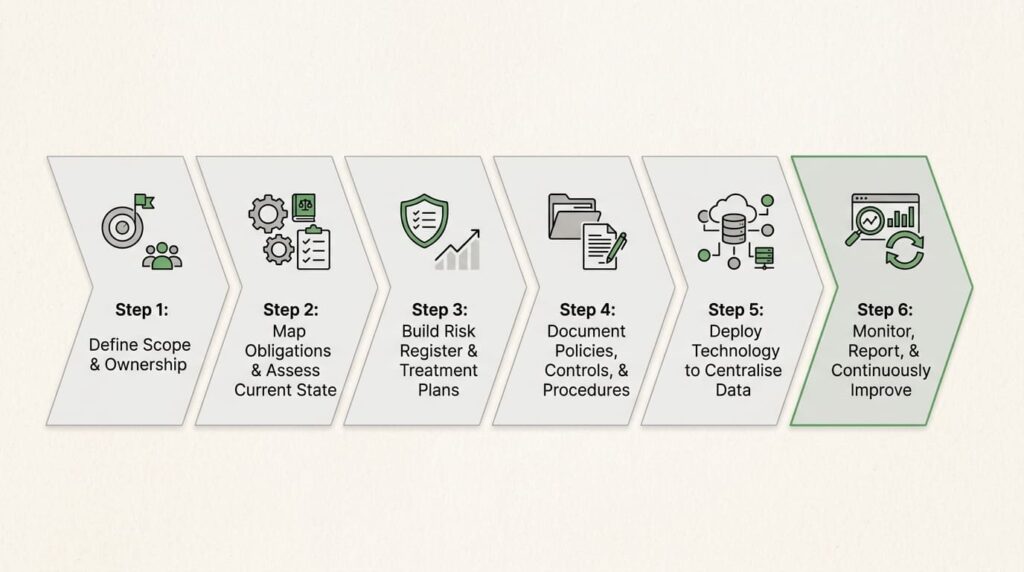
Implementing an integrated GRC program is a journey of capability, not a single project. The following six steps provide a coordinated path from current state to mature operation.

Step 1, Define Scope and Governance Ownership

You cannot protect what you have not defined. Start by identifying the boundaries of your GRC program. Is it for the entire organisation or a single business unit? Just as importantly, you must assign clear governance ownership. This usually means establishing a Risk Committee or a dedicated GRC Lead with authority to drive change across the organisation. Without ownership at the executive level, the program will stall before it produces meaningful outcomes.

Step 2, Map Obligations and Assess Current State

Before you build anything new, understand what you already do. List every Act, Standard, and internal policy that applies. Conduct a gap analysis to see where you meet your obligations and where you fall short. This baseline gives you the evidence to justify investment in better systems, prioritise effort by materiality, and avoid duplicating controls already in place. Our Risk Maturity Assessment provides a structured starting point.

Step 3, Build the Risk Register and Risk Treatment Plans

Identify your strategic and operational risks, and record them in a centralised register. For each risk, assess the current level, decide on the most effective risk treatment (mitigate, share, accept, or avoid), and document the residual (target) level. This is where you set your risk appetite, the level of risk you are prepared to live with to achieve your objectives. Every treatment plan needs a clear owner, a deadline, and an evidence trail to confirm the treatment was delivered.


Step 4, Document Policies, Controls, and Procedures

Codify the rules. Policies explain what needs to be done. Procedures explain how. Controls link the two and reduce risk to acceptable levels. Map each policy and control directly to the risks it is intended to mitigate. For example, an Information Security Policy should be an explicit control for your Data Breach Risk. This mapping is the heart of an integrated GRC framework and is what auditors look for first.

Step 5, Deploy Technology to Centralise Data

Manual systems are the single biggest point of failure in GRC. Spreadsheets are prone to error, create data silos, and offer no real-time visibility. Deploying a purpose-built platform like Skefto centralises risks, incidents, obligations, controls, and reports in a single source of truth. The automation, the audit trails, and the dashboards required for modern GRC are not realistic outside a dedicated platform.

Step 6, Monitor, Report, and Continuously Improve

Once the system is live, the focus shifts to operating discipline. Track key risk indicators and compliance status in real time. Conduct regular internal audits to verify that controls are working as designed. Use insights from incident management to drive continuous improvement. A mature GRC program never stands still, it learns from every audit, every incident, and every regulatory update.

GRC Software: What to Look For in a Platform

When choosing a platform to support your framework, look past the marketing surface. For an Australian organisation, the following six criteria are non-negotiable.

Australian Data Sovereignty

Know where your data is stored. Look for vendors who host data in government-certified Australian data centres. This simplifies compliance with the Privacy Act 1988, supports state-based public sector requirements, and removes friction with security teams who need to know jurisdiction and access controls at a glance.

No-code Configurability

Your GRC framework should fit your organisation, not the reverse. Avoid heavy-code systems that require external developers every time you need a new form, field, or risk category. A no-code platform lets your risk and compliance teams adapt the system themselves, which keeps the framework agile as regulations and operations evolve.

Integrated Risk, Incident, Compliance, and Strategy Modules

The point of GRC is integration. The platform must offer separate but linked modules for risk management, incident tracking, compliance obligations, safety, and strategic planning. A risk in the register should connect directly to the incidents it has caused, the controls that mitigate it, and the obligations it relates to. Linkage is what unlocks insight.

Board-Ready Reporting and Dashboards

You should not need a data analyst to brief the board. The platform must produce visual, intuitive dashboards: heatmaps, trend charts, traffic-light indicators, and concise narrative reports that can be exported directly into board papers without manual rework.

Full Audit Trail and Version Control

Accountability lives in the audit trail. The system must capture every change made to every record, including who made it, what changed, and when. Robust version control on policies and procedures ensures staff always work from the current, approved version, not a stale copy in a shared drive.

Sector-Specific Templates

A good platform comes with pre-built templates for your sector, whether that is Local Government, Aged Care, Disability Services, Education, or State Government. Templates that pre-map relevant legislation and standards significantly compress your time to value.

GRC by Australian Sector

The principles of GRC are universal, but their application varies sharply across Australian sectors. The following examples illustrate how the discipline plays out in practice.

Local Government

Councils manage a unique blend of community, financial, asset, and regulatory risk. GRC for local government centres on compliance with state-specific Local Government Acts, integrity frameworks to prevent fraud and corruption (supervised by bodies such as IBAC in Victoria and ICAC in New South Wales), transparent reporting to ratepayers, and the management of large asset portfolios alongside the safety risks tied to public spaces and events.

State Government and Statutory Authorities

At the state level, GRC is shaped by the PGPA Act for Commonwealth bodies and equivalent state public administration Acts elsewhere. The focus is on strategic risk, financial accountability, and complex central-agency reporting. State agencies are also at the forefront of digital transformation, which makes cyber GRC a board-level priority and aligns the function closely with information security teams.

Aged Care

For aged care providers, GRC underpins quality and safety. The focus is on the Aged Care Act 2024, the revised Aged Care Quality Standards, the Aged Care Rules 2025, and the Serious Incident Response Scheme (SIRS). Providers must evidence clinical governance, driving continuous improvement, and consumer rights to retain registration, maintain Star Ratings, and secure funding under the new framework.

Disability Services and NDIS

NDIS providers operate under the supervision of the NDIS Quality and Safeguards Commission. GRC in this sector focuses on participant safety, reportable incident management, worker screening, and adherence to the NDIS Practice Standards. The ability to demonstrate ongoing compliance during mid-term and recertification audits is critical to maintaining registration and protecting revenue.

Education

Schools, TAFEs, and universities use GRC to manage a broad spectrum of risk, from Child Safe Standards, psychosocial safety, and tackling cyber threats through to financial accountability and research integrity. For higher education providers, ongoing compliance with TEQSA (the Tertiary Education Quality and Standards Agency) is the primary driver of a mature GRC framework, sitting alongside WHS, privacy, and child safety obligations.

Common GRC Mistakes Australian Organisations Make

Industry observation shows that even well-resourced organisations fall into the same five traps. Avoid them deliberately.

  1. Treating GRC as a tick-box exercise. If you only think about GRC when an audit is approaching, you forfeit the strategic value. GRC should be a continuous capability that improves decisions, not a bureaucratic chore that consumes resources without producing insight.
  2. Operating in silos. When risk, compliance, audit, and safety teams work in isolation, they create blind spots and duplicate effort. Integration is the I in GRC, and it is the difference between a framework and a filing cabinet.
  3. Spreadsheet sprawl. Running risk and compliance from hundreds of disconnected spreadsheets offers no version control, no audit trail, and no real-time visibility. It is also the most common single cause of failed external audits.
  4. Reactive incident management. Fixing the immediate symptom without genuine root-cause analysis guarantees you will see the same incident again. Mature providers analyse, learn, and adjust controls.
  5. 5. Underinvesting in culture. Technology amplifies discipline, it does not create it. GRC ultimately fails without a risk-aware culture where every employee understands their role in protecting the organisation.

Frequently Asked Questions

What does GRC stand for?

GRC stands for Governance, Risk, and Compliance. It is an integrated discipline that aligns leadership, risk management, and regulatory adherence under one coordinated framework. The term was coined by the Open Compliance and Ethics Group (OCEG), and it has become the global shorthand for the capabilities that help organisations operate ethically, legally, and effectively.

What is a GRC framework?

A GRC framework is a structured system of policies, processes, roles, and technology that an organisation uses to integrate its governance, risk management, and compliance activities. A typical framework includes a risk register, an obligation register, policies and controls, incident management, internal audit, and board reporting. The framework links these elements so decisions are evidence-based and obligations are continuously met.

Is GRC the same as ERM?

No, but they overlap. ERM (Enterprise Risk Management) is the discipline of identifying, assessing, treating, and monitoring risks across the entire enterprise. GRC is broader, it integrates governance and compliance with ERM under one strategic umbrella. In practice, ERM operates inside the wider GRC framework, providing the risk intelligence that boards and executives need to make decisions and meet obligations.

What is GRC in cyber security?

In cyber security, GRC refers to the integration of cyber governance, cyber risk management, and information security compliance. It links board-level oversight of cyber risk to operational controls under frameworks such as ISO 27001 and the NIST Cybersecurity Framework, and to legal obligations under the Privacy Act 1988, the Notifiable Data Breaches scheme, and APRA CPS 234 for regulated entities.

What are the three pillars of GRC?

The three pillars of GRC are Governance, Risk Management, and Compliance. Governance provides direction, oversight, and accountability. Risk Management identifies and treats uncertainty against objectives. Compliance ensures the organisation meets its legal, regulatory, and internal obligations. When the three pillars are integrated, they form a unified system that strengthens decision-making and resilience.

Why is GRC important for Australian organisations?

GRC is essential for Australian organisations due to intensifying regulatory pressure (APRA CPS 230, the Aged Care Act 2024, NDIS reforms, Privacy Act amendments), growing personal accountability for directors under the Corporations Act 2001 and the PGPA Act, and the rising cost of public trust failures. A mature GRC framework helps boards demonstrate due diligence and ensures critical obligations are met continuously, not just at audit time.

What is the OCEG GRC Capability Model?

The OCEG GRC Capability Model, also known as the Red Book, is the global reference framework for GRC. Maintained by the Open Compliance and Ethics Group, it organises GRC into four continuous components: Learn (understand context), Align (set objectives and risk appetite), Perform (implement actions and controls), and Review (assess effectiveness). Its goal is what OCEG calls Principled Performance.

How long does it take to implement a GRC framework?

Most Australian organisations reach a functional GRC capability within six to twelve months and a mature one within eighteen to twenty-four months. The exact timeline depends on the size of the organisation, the maturity of existing processes, the complexity of the regulatory environment, and the level of executive sponsorship. Starting with a focused pilot in one business unit before scaling enterprise-wide is the fastest route to value.

Strengthen Your GRC with Skefto

Skefto is a flexible, all-in-one platform that helps Australian organisations manage governance, risk, incidents, compliance, safety, and strategic planning from a single source of truth. Data is hosted in government-certified Australian data centres, the platform is no-code configurable, and it ships with sector-specific templates for local government, state government, aged care, disability services, and education. Our team also delivers independent risk advisory services and the Risk Maturity Assessment to help you benchmark and strengthen your program. If you are ready to move from spreadsheets to a unified GRC capability, book a demo or take the Risk Maturity Assessment today.

A tailored platform that allows all information to be easily captured, work flowed, and analysed

Author Note

I wrote this guide because Australian leaders deserve a clear, locally relevant answer to what GRC actually means in 2026. My work on ISO 22336 and with public sector clients across Australia keeps reinforcing the same lesson: organisations that integrate governance, risk, and compliance early are the ones that anticipate, absorb and adapt to change fast, meaning they can survive and prosper and earn lasting trust. If you are working to lift your organisation’s risk maturity, I would be glad to help.

Share This Page
Receive updates of our top blogs, guides, and White papers straight to your inbox
Picture of Pete Gervasoni

Pete Gervasoni

I'm the Chief Risk Officer and organisational resilience expert at Skefto Innovations. I've been in the game for over 20 years, serving in senior risk and resilience roles across Local, State and Federal Government organisations. I've worked with Councils, Boards and Executives to support the successful execution of strategy by embedding risk frameworks, organisational resilience frameworks, business continuity management systems and innovation programs. I've previously led and delivered transformational change in risk management and enhancing organisational cultures. For the past five plus years, I've been educating the Victorian Public Sector in risk management. Skefto is LG Pro Victoria’s risk education partner, together with IPAA-ACT. I'm a nominated expert to the International Standards Organization (ISO) having led a global project for the development of a new international standard ISO 22336: Organizational resilience - Guidelines for resilience policy and strategy which was published in 2024. I'm a Fellow of the Institute of Strategic Risk Management (ISRM), and the current Deputy Chair of ISRM's Victoria/SA Chapter. Fun fact: I'm also a singer / songwriter who performed in front of more than 75,000 people at the MCG on Anzac Day.