


Written by
Kosta Nicolaou
Director, Skefto
Fact-checked
Most incident report templates I found online were written for the US or the UK. They don’t mention notifiable incidents, calling 000 or your state regulator. So I built one for Australian workplaces. It’s free, it comes in Word and PDF, and you can download it without giving us your email.
Key takeaways
- Free download in Word (editable) and PDF (print and fill by hand). No email needed.
- Built for Australian workplaces. It has a notifiable incident check, a site preservation question and a regulator reference field.
- It already includes the new categories added to the model WHS Act in December 2025. They’re marked clearly, because they only apply once your state or territory adopts them.
- The form doesn’t stop at “what happened”. It ends with causes and corrective actions, each with an owner and a due date.
Download the template
Pick the format that suits how your team works.
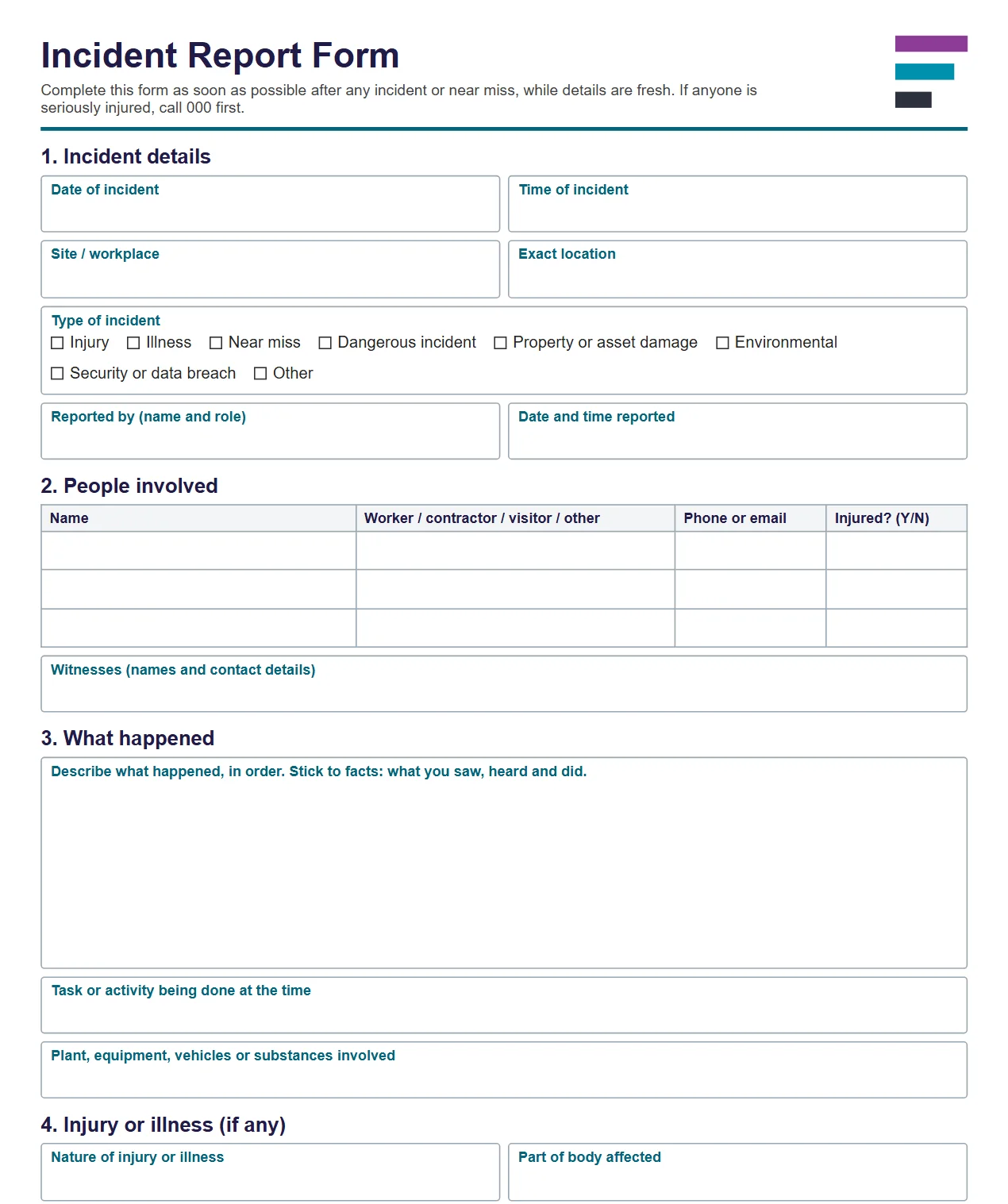
The form is A4 and runs to three pages. Print a few and keep them where incidents tend to happen, like the workshop, the front desk or the site vehicle.
What’s in the form, section by section
I kept every field that an investigator or regulator is likely to ask about, and dropped the rest.
- Incident details. Date, time, site, exact location and type of incident. Exact location matters more than people think. “Warehouse” is not enough. “Aisle 4, near the loading dock door” is.
- People involved. Everyone involved, whether worker, contractor, visitor or member of the public, plus witnesses and how to reach them.
- What happened. A short, factual account in order, the task being done, and any plant, equipment or substances involved.
- Injury or illness. What the injury was, which part of the body, and what treatment was given, from first aid to a hospital admission.
- Immediate actions. What was done straight away to make the area safe, and whether the area was isolated.
- Notifiable check. Did it involve a death, a serious injury or illness, or a dangerous incident? If so, there are fields for when the regulator was notified, by whom and the reference number.
- Investigation and corrective actions. The causes found and a table of actions, each with an owner, a due date and a completed date.
- Sign-off. Supervisor and manager review, with dates.
Which incidents you must report to the regulator
Under the WHS laws, a business must notify its WHS regulator immediately after becoming aware of a death, a serious work-related injury or illness, or a dangerous incident. The site has to be left undisturbed until an inspector arrives or the regulator says otherwise. You also need to keep a record of a notifiable incident for at least five years. Victoria has its own OHS laws with similar but separate rules.
In December 2025, Safe Work Australia published changes to the model WHS Act. They add new incidents that must be notified:
| New category | What it covers |
|---|---|
| Violent incidents | Including sexual assault |
| Work-related suicide | Including attempted suicide |
| Extended absences | A worker off work for 15 or more calendar days |
| Dangerous incidents | Now also covers certain incidents involving mobile plant and falls |
These changes only take legal effect once your state or territory adopts them, and each one sets its own timeline. That’s why the form lists them in a separate row marked “only notifiable once your state or territory adopts them”. Check with your regulator before you change how you report.
How to fill it in so it holds up later
The form only helps if what’s written on it is accurate. A few habits make the biggest difference:
- Fill it in the same day. Details fade fast, and witnesses go home.
- Write facts, not blame. “The pallet jack rolled back on the ramp” is useful. “Sam wasn’t careful” isn’t.
- Record the task, not just the injury. Most fixes come from understanding what the person was trying to do.
- Give every action an owner and a date. An action with no owner is a wish.
If you want more help with the written account, we’ve covered it in how to write an incident report.
Other reporting rules that may apply to you
The WHS rules aren’t the only ones. Depending on your sector, the same incident may need a second report:
- NDIS providers must notify reportable incidents to the NDIS Quality and Safeguards Commission, most within 24 hours, with a more detailed report to follow. See how Skefto supports disability services.
- Aged care providers must report serious incidents to the Aged Care Quality and Safety Commission, with the most serious due within 24 hours. See how Skefto supports aged care.
- Data breaches that are likely to cause serious harm may need to be reported under the Notifiable Data Breaches scheme run by the OAIC.
The form has a “Security or data breach” tick box so these incidents land in the same register, even though the reporting path is different.
When a paper form stops working
A paper or Word form is fine for a small team with a few incidents a year. It starts to hurt when:
- forms sit in someone’s inbox and nobody knows a notifiable incident happened
- corrective actions are written down but never followed up
- you need a report for the board or a safety committee and have to retype every form into a spreadsheet
That’s the gap Skefto’s incident management software fills. The same fields become a mobile form with conditional logic. The right people get an alert based on the type and severity of the incident. Each incident links to corrective actions with owners and due dates, and the dashboards show trends without any retyping.
Frequently asked questions
How do I create an incident report form?
Start with the questions an investigator will ask: what happened, when, where, who was involved, what was done straight away, and what will stop it happening again. Add a check for notifiable incidents and a sign-off. Or download the template on this page and edit the Word version.
Can I download a free incident report form in Word?
Yes. The Word version on this page is free and editable, and there’s no email form. You can add your logo, change fields or remove sections you don’t need.
What is the proper format for an incident report?
A good format moves in order: incident details, people involved, a factual description, injuries and treatment, immediate actions, notification, causes and corrective actions, then sign-off. That’s the order this template follows.
What are the 5 elements of a good incident report?
It’s usually summed up as who, what, when, where and why. A report that holds up also records what was done straight away, and the corrective actions with an owner and a due date.
Do I need to report near misses?
A near miss isn’t notifiable to the regulator unless it’s a dangerous incident, such as an uncontrolled gas leak or a collapse. But it’s worth recording every near miss on the form. They show you where the next injury is likely to happen.
How long should I keep incident reports?
Under the WHS laws, keep a record of every notifiable incident for at least five years. Many organisations keep all incident reports for the same period to keep things simple.
Stop chasing paper incident forms
Skefto turns this form into a mobile form with automatic alerts, linked corrective actions and audit-ready reports, built for Australian organisations.
Sources
- Safe Work Australia, incident notification: safeworkaustralia.gov.au/safety-topic/managing-health-and-safety/incident-notification
- Safe Work Australia, notifiable incidents fact sheet (Dec 2025): safeworkaustralia.gov.au/sites/default/files/2026-03/whs_notifications_incidents_extended_absences_suicides_factsheet_dec2025_update.pdf
- NDIS Quality and Safeguards Commission, reportable incidents: ndiscommission.gov.au/rules-and-standards/reportable-incidents-and-incident-management/reportable-incidents
- Aged Care Quality and Safety Commission, reportable incidents: agedcarequality.gov.au/providers/serious-incident-response-scheme/reportable-incidents/about-reportable-incidents
- OAIC, Notifiable Data Breaches scheme: oaic.gov.au/privacy/notifiable-data-breaches
Checked 13 November 2026. Notification rules differ by state and territory; confirm with your WHS regulator.