
July 12, 2026 · 11 min read
Risk AI is changing how risk managers draft assessments, maintain registers, and report to boards. Here is what that looks like in practice – and where the limits still sit.
Risk AI – generative AI applied specifically to risk management work – is already being used by more than 50% of risk and compliance professionals, up from 30% in 2023. The most practical near-term applications are drafting risk assessments faster and more consistently, keeping risk registers current without constant manual upkeep, generating board-ready narrative reports from structured data, and identifying emerging risks earlier by scanning across more sources than any individual could read. The limits are real – hallucination, data confidentiality, and the need for qualified human sign-off are not small caveats. But for teams stretched thin across complex, regulated organisations, Risk AI offers something that matters: more capacity to do the work that actually requires judgement. Skefto is built to be the platform where that work happens safely.
What is Risk AI – and why does it matter now?
Risk AI is not a single product or a vendor category. It is a practical term for what happens when generative AI capabilities – large language models that produce structured text, assessments, and documents from natural language prompts – are applied to the specific workflows of risk management.
That distinction matters. General-purpose AI tools like ChatGPT can produce text that looks like a risk assessment. Risk AI, properly understood, produces risk assessments that are grounded in your organisation’s own risk data, aligned to your approved framework and taxonomy, and embedded in an auditable workflow where a qualified risk manager reviews and signs off the output.
The backdrop that makes this urgent: ransomware attacks against critical sectors grew 34% year on year in 2025, per Kela Cyber. Global cybercrime is projected to cost USD 12.2 trillion annually by 2031. Risk environments are growing more complex faster than risk team headcounts are growing. The organisations that figure out how to do more with the same capacity – that is, the organisations that adopt Risk AI effectively – will manage risk more effectively than those that do not.
Risk management has always generated more paperwork than it gets credit for. A single risk assessment for a new project might run to several pages. A risk register across a local council, government department, or medium to large organisation might hold hundreds of entries, each requiring periodic review, treatment updates, and evidence of control effectiveness. A quarterly board risk report synthesises all of that into something a non-specialist board can read and act on.
Most of that writing follows predictable structures. The consequence and likelihood scales are defined. The treatment categories are established. The reporting format is standardised. The frameworks – AS/ISO 31000, APRA CPS 220, sector-specific standards – provide the architecture. What varies is the specific content: the nature of the risk, the relevant controls, the organisational context.
That combination – structured format, variable content – is exactly where Risk AI has something to offer. It does not replace the risk judgement. It removes the bottleneck between the judgement and the documented output.
What Risk AI actually does for risk management teams
“Risk AI” covers a lot of ground. Here are the five applications where it is earning its keep in practical risk management programs right now.
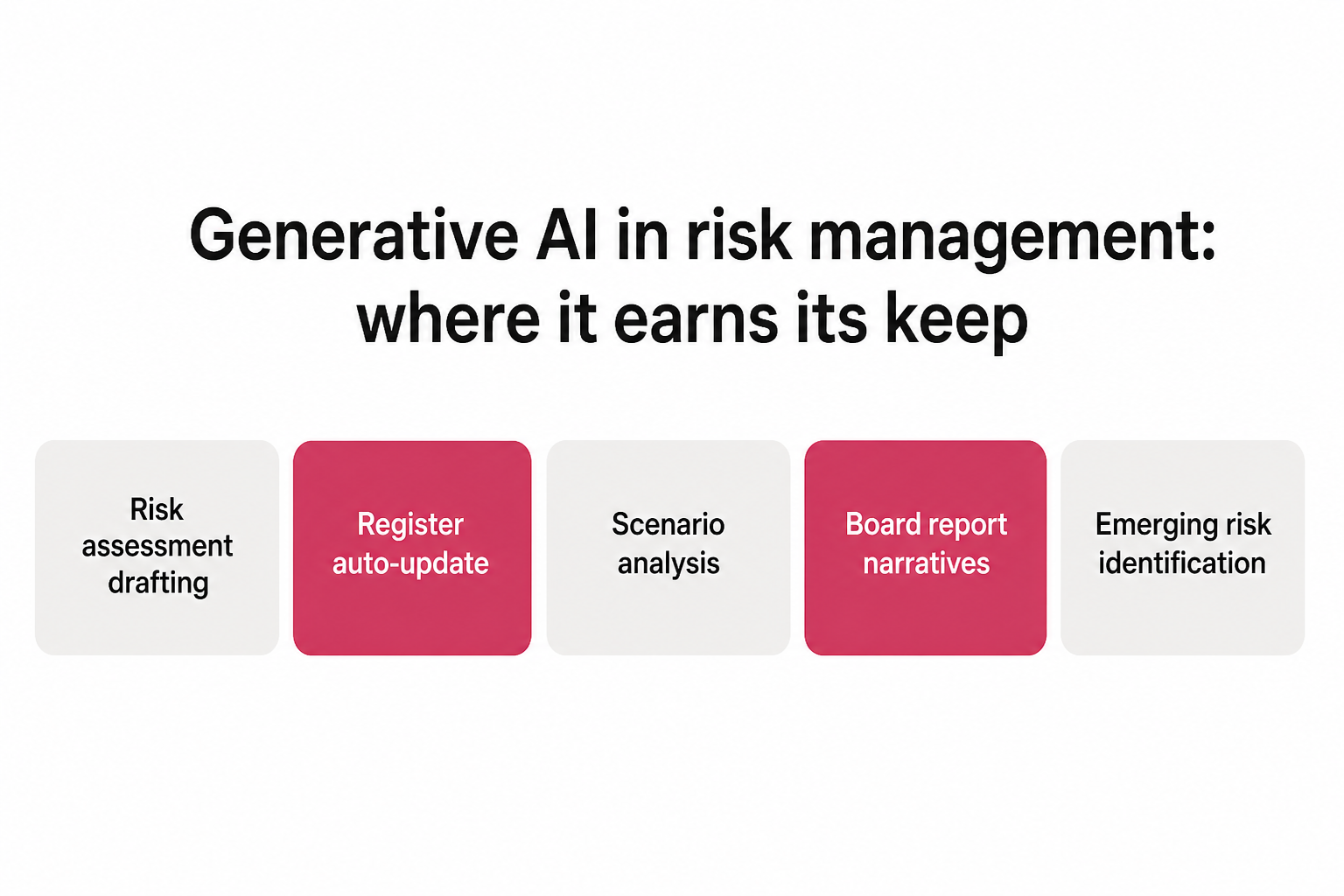
Risk assessment drafting. Completing a risk assessment for a new project, vendor, or operational change involves a predictable set of questions: What could go wrong? How likely is it? What is the potential impact? What controls exist? What treatment is proposed? Risk AI can produce a structured first draft based on similar historical assessments in your register, the specific context provided by the risk manager, and your organisation’s risk criteria. The risk manager reviews, corrects, and signs off – but they start from a draft that already follows the right format and draws on relevant precedents, rather than a blank template.
Risk register maintenance. Risk registers degrade when they are not regularly updated, and manual upkeep is slow. When a new incident occurs, someone has to check whether it surfaces a new risk or escalates an existing one. When a regulation changes, someone has to trace the downstream effect on relevant controls. Risk AI can surface those connections automatically – flagging which register entries are affected by a new incident report or regulatory update – so the risk manager can review the suggested updates rather than hunting for them manually.
Board and executive reporting. Transforming a risk register into a coherent board paper is skilled work that takes time. The data is there; the problem is synthesis. Risk AI can draft the narrative sections – summarising the risk profile, explaining movements in the heat map, describing control performance, flagging emerging risks for board attention – from the structured register data. The risk manager reviews and refines, rather than writing from scratch. For organisations producing quarterly risk reports, this is a consistent and significant time saving.
Scenario analysis. Risk AI can help stress-test risk assumptions by generating plausible scenarios: “What would the impact be if our primary software vendor suffered a prolonged outage?” or “How would a 15% funding cut affect our risk treatment capacity?” The model draws on your existing risk data and organisational context to produce structured scenarios that a risk manager can then evaluate and refine. This is not prediction – it is structured prompting of possibilities that a human then applies professional judgement to.
Emerging risk identification. Risk identification has traditionally depended on what risk managers already know, supplemented by periodic horizon-scanning exercises. Risk AI can scan across more sources – incident databases, regulatory updates, sector publications, news – than any individual could read, and surface patterns that might indicate an emerging risk category. The risk manager still decides on what is material; Risk AI widens the field of view.
Risk AI and the register maintenance problem
The risk register is where Risk AI’s impact on day-to-day risk management is most immediate.
Registers fail in predictable ways: entries that have not been reviewed for months, treatment actions marked complete but not actually effective, risk descriptions written by someone who has since left and no longer reflects current operations, likelihood ratings not updated since a major incident changed the risk environment.
All of this happens because maintenance requires time that risk managers rarely have. Every update to a risk entry is a judgment call that requires context – it is not data entry, even when it looks like it.
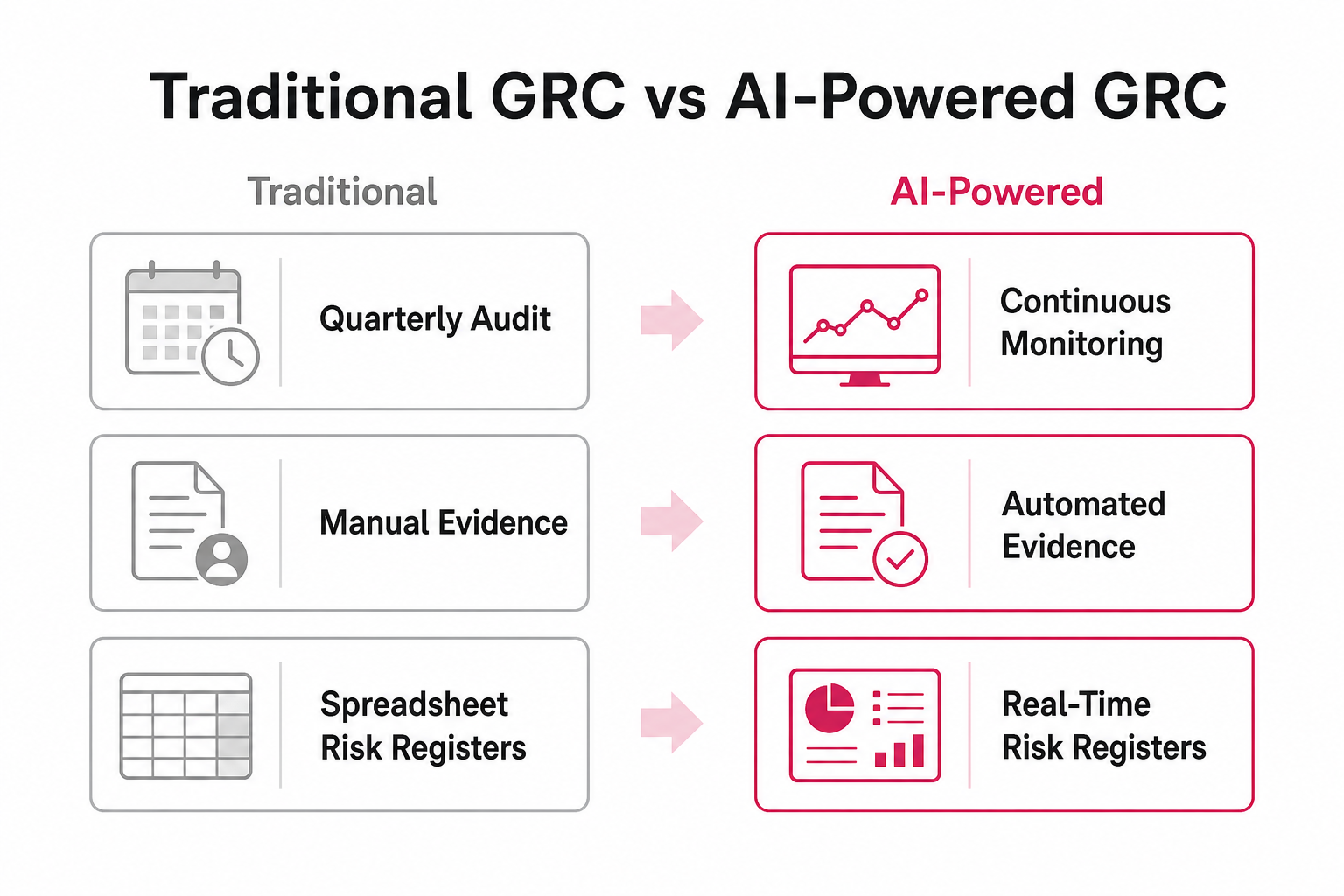
Risk AI changes this by shifting the task from writing to reviewing. Instead of opening a risk entry and deciding what to change, a risk manager opens it to find a suggested update – based on a new incident, a control assurance result, a regulatory change – and decides whether the suggestion is right. That is faster, and it surfaces updates that manual processes would miss.
The risk register is only as useful as it is current. Risk AI does not keep it current automatically – but it closes the gap between what needs updating and what actually gets updated.
The prerequisite is a structured, integrated risk platform. Skefto’s enterprise risk management software connects risk registers, incident data, control assurance results, policies, and compliance obligations in a single system – the kind of unified data environment where Risk AI-assisted register maintenance is practical rather than aspirational.
The hallucination problem: why human sign-off still matters
Risk AI has the potential to makes things up. This is not a fault that will be corrected in the next version – it is an inherent property of how large language models work. The model produces the most statistically likely output based on its training data, not a verified fact. When it lacks grounded information, it fills the gap with plausible-sounding content.
In risk management, this creates a specific danger. A risk assessment that misquotes an AS/ISO 31000 standard, rates a likelihood incorrectly against your approved risk criteria, or references a control that does not exist creates a document that looks authoritative and is wrong. If that document feeds into a board risk report or a regulatory submission without being caught, the consequences can be significant.
96% of IT leaders believe AI adoption creates security risk, per IBM Institute for Business Value research. For risk managers, the specific risk is professional: you are accountable for the accuracy of your risk program’s outputs, including the ones initially drafted by Risk AI.
The mitigation is workflow design, not Risk AI avoidance. Every AI-drafted risk document should be treated as a working draft – a starting point for qualified review, not a finished output. The risk manager who reviews and signs off on a Risk AI-assisted assessment is not rubber-stamping it; they are exercising the professional judgement that makes the document reliable.
“The shift is not from human expertise to AI. It is from humans doing everything manually to humans reviewing and directing AI outputs. The expertise does not disappear – it changes how it is applied.” – Moody’s, Risk and Compliance in the Age of AI, 2025
What Risk AI means for risk managers specifically
Moody’s 2025 survey of 600 risk and compliance professionals is worth reading carefully for the role evolution data. Over 80% expect their role to remain but change. More than 60% anticipate more strategic and advisory responsibilities. Around 50% expect to focus more on exception handling and oversight.
For risk managers, that translation is concrete. Less time drafting assessments from blank templates. More time on the judgment calls that require context – deciding whether a new risk category is material, whether a control is genuinely effective or just documented, whether a trend in the heat map reflects a real change in the organisation’s risk environment. Those are the parts of the job that require a qualified risk professional. Risk AI does not replace them; it creates more capacity for them.
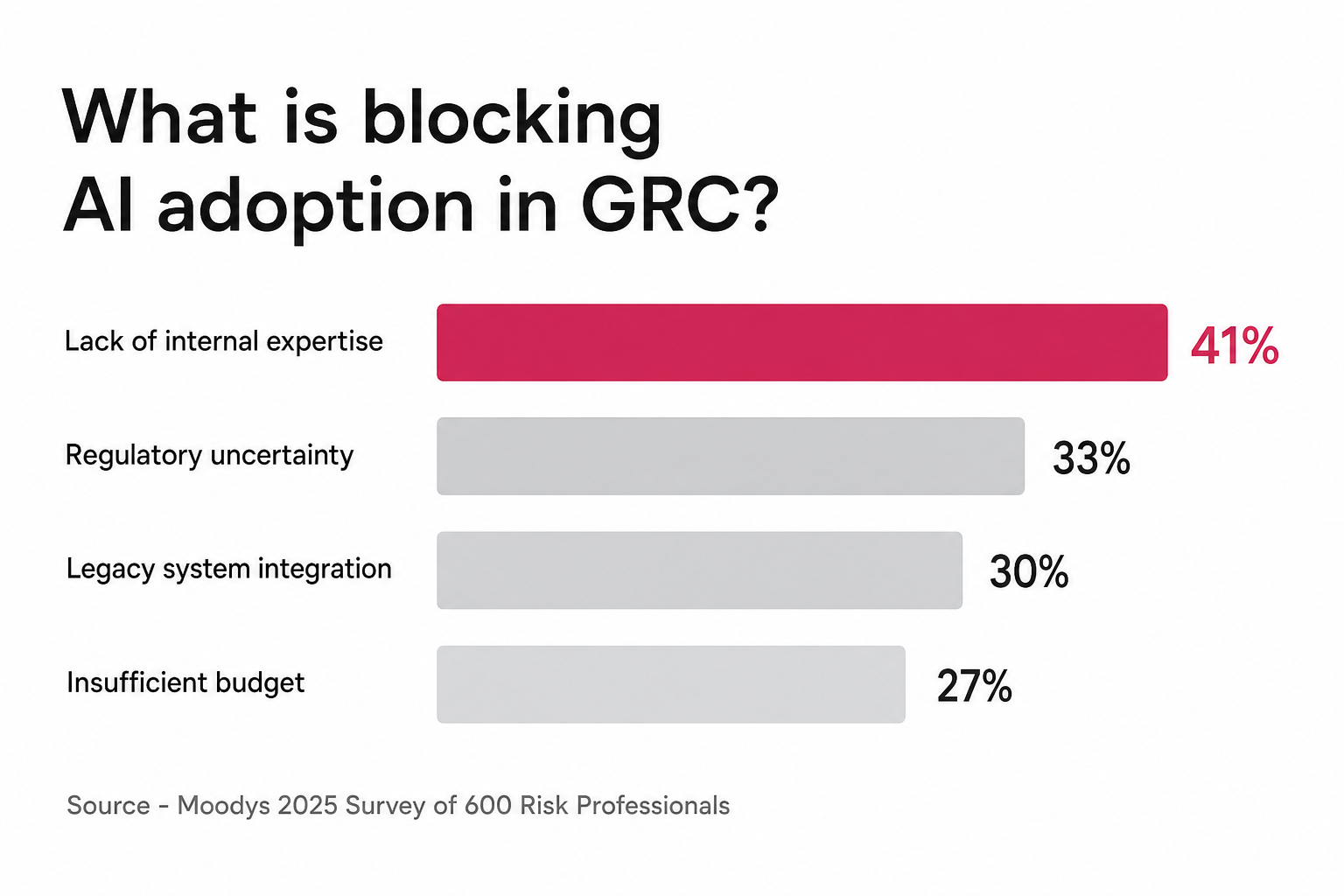
The 41% who cite lack of internal expertise as the top barrier to Risk AI adoption are not wrong to be cautious. Effective use of Risk AI in risk management requires enough technical literacy to interrogate outputs, catch hallucinations, and recognise when the model has generated something plausible that is factually wrong. This is not a high bar – it is closer to the critical reading skills a risk manager already applies to any document – but it does require deliberate attention, particularly in the early stages of adoption.
The organisations that will get the most from Risk AI are those with two things already in place: a structured, well-maintained risk platform with consistent data, and a risk team with the professional confidence to review AI outputs critically rather than accepting them at face value.
Risk AI in the Australian context: AS/ISO 31000 and data sovereignty
Australian risk management operates within a specific regulatory and standards environment that shapes how Risk AI can be used safely.
AS/ISO 31000 defines the principles and guidelines that Australian risk programs are built on. APRA CPS 220 governs risk management for APRA-regulated entities with specific requirements for risk appetite frameworks, stress testing, and board-level risk oversight. Sector frameworks in local government, state and federal government, aged care, education, and disability services add further layers that shape how risks are categorised, assessed, and reported.
Risk AI that is embedded in a platform built around these frameworks – where the templates, taxonomies, and reporting structures already reflect AS/ISO 31000 and sector requirements – produces outputs that fit the organisation’s actual risk program rather than requiring extensive reworking to match local standards.
The data sovereignty dimension is non-negotiable for most Australian public sector and regulated organisations. Risk register data is sensitive by definition: it describes control weaknesses, strategic vulnerabilities, and unresolved treatment actions. Submitting that data to a public generative AI service – even for a single assessment draft – creates exposure that cannot be undone. The only safe path is Risk AI that operates within a certified Australian data environment, where the data never leaves the boundaries of appropriately governed infrastructure.
The NIST AI Risk Management Framework and the EU AI Act are already influencing how Australian regulators think about AI governance. Risk managers who understand these frameworks now will be better positioned when Australian-specific Risk AI governance requirements crystallise – and they should be treated not just as compliance obligations but as a natural extension of the risk management work already being done.
Try Skefto
Skefto is a risk management platform built by practitioners for Australian regulated organisations – local and state and federal government, aged care, disability services, and education. Its enterprise risk management software brings risk registers, control assurance, incident data, and compliance obligations into one integrated system, aligned to AS/ISO 31000 requirements, hosted exclusively in government-certified Australian data centres.Skefto enterprise risk management software demonstrating Risk AI capabilities for Australian risk teams, as taken from Skefto
If your organisation is ready to move beyond static, spreadsheet-based risk registers and start capturing what Risk AI can do in a structured, auditable workflow, book a demo or start with Skefto’s free Risk Maturity Assessment to understand where your program sits today.
Frequently Asked Questions
What is Risk AI?
Risk AI refers to generative AI tools and capabilities applied specifically to risk management work – drafting risk assessments, maintaining risk registers, generating board reports, running scenario analysis, and identifying emerging risks. Unlike general-purpose AI, Risk AI is most effective when embedded in a purpose-built risk platform that grounds outputs in your organisation’s own risk data, framework, and taxonomy. Skefto’s enterprise risk management software is designed to be that platform for Australian regulated organisations.
Is Risk AI replacing risk managers?
No – and the data makes this clear. Moody’s 2025 survey of 600 risk and compliance professionals found over 80% expect their role to remain but evolve toward more strategic and advisory work. Risk AI handles drafting, summarising, and structured document production. Risk managers handle professional judgement, contextual interpretation, and accountability – work that AI cannot reliably do.
What is the biggest risk of using Risk AI in risk assessments?
Hallucination – where the model generates plausible-sounding but factually wrong content – is the most serious concern. A risk assessment that misquotes a standard, overstates a likelihood rating, or references a non-existent control creates organisational and professional liability. The mitigation is treating every Risk AI output as a draft requiring qualified human review before it becomes part of the official risk register. Never submit live risk register data to a public AI tool – data sovereignty and confidentiality matter here.
How does Risk AI support AS/ISO 31000-aligned risk management?
Risk AI can operationalise AS/ISO 31000 requirements more consistently across an organisation by structuring risk assessments to a standard template, ensuring consequence and likelihood language aligns with your approved risk criteria, and drafting treatment plans that follow a consistent format. Skefto”s risk management software is built around AS/ISO 31000 alignment, so Risk AI outputs inherit that structure automatically.
Is it safe to use public AI tools like ChatGPT as Risk AI for draft assessments?
No – for two reasons. First, risk register data (incident details, control failures, strategic risk descriptions) is commercially sensitive and should not be submitted to a public AI tool’s servers. Second, public AI tools are not grounded in your organisation’s specific risk framework, so their outputs require extensive correction before they match your taxonomy, scales, or treatment approach. The safe path is Risk AI embedded within a purpose-built risk platform that operates within certified Australian data infrastructure.
