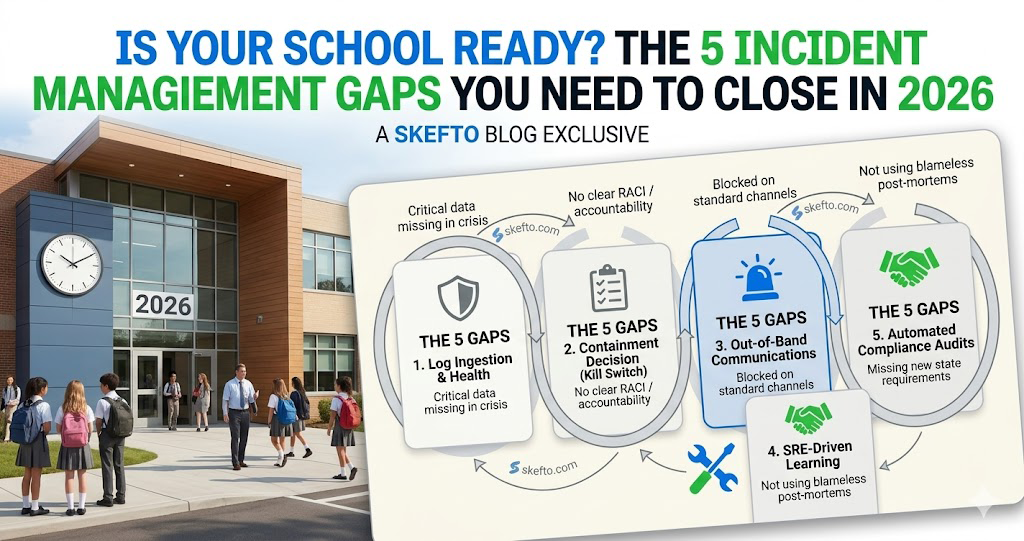
When a crisis hits a school, every second becomes a critical decision point. Furthermore, we often talk about “lockdown mode” as the ultimate safety measure, but in reality, a lockdown represents just one piece of a much larger puzzle. Consequently, the first five minutes of an incident don’t just reveal your plan; they reveal your preparation. If that preparation contains significant holes, the results can quickly become chaotic. Currently, we’re seeing a major shift in how Australian schools and universities approach safety. Schools are moving away from a “compliance-only” checklist and adopting a “readiness culture” where every staff member knows their role and systems work together seamlessly. However, even the most dedicated school leaders can overlook critical vulnerabilities, often failing to capture the full story in a timely incident report.
These vulnerabilities are not just technical glitches; they represent strategic failures. To build true organisational resilience, we must bridge the school incident management gaps that often hide in plain sight.
What is school incident management?
At its heart, school incident management provides the structured framework that schools use to identify, respond to, and recover from any event threatening the safety of students, staff, or operations. This includes everything from the initial alert to the final incident report that documents what happened and how the school responded. In addition, these incidents range from natural hazards like storms or floods to technological failures, medical emergencies, and human-caused threats.
In the Australian context, rigorous standards like AS/ISO 31000 increasingly govern this process, providing a professional framework for risk management. Effective management typically falls into a few key categories:
- Prevention and Mitigation: Using structured assessments and hazard mapping to identify risks before they escalate into incidents.
- Preparedness: Training staff and conducting regular drills to build the muscle memory needed for high-stress situations.
- Response: The actions staff take during a crisis, such as lockdowns or evacuations, to protect lives.
- Recovery: Reuniting families, providing psychological support, and restoring normalcy over the long term.

Since school violence has reached a 20-year high, the pressure to close every possible gap has never been greater. Consequently, let’s break down the five most critical gaps you need to address.
Gap 1: The integration gap When safety solutions sit in silos
One of the biggest issues surrounding school emergency plans is the reliance on disparate and disconnected solutions. It’s common to find schools where risk assessments live in one spreadsheet, incident logs in another software, and compliance checklists in a third. These systems rarely talk to each other, leaving school leaders with a fragmented view of their actual readiness.
This fragmentation creates a dangerous lack of visibility. Moreover, when an event occurs, the subsequent incident report often reveals that staff had already identified the underlying risks but had not yet linked them to a response plan. Without a unified system, silos trap critical information, and the school remains reactive rather than proactive.
Ultimately, we believe that schools should integrate a modern incident management system into a broader, cohesive ecosystem. In our platform, incident, risk, and compliance modules work together. Specifically, an incident automatically alerts risk owners and triggers treatment actions, ensuring every stakeholder stays informed. This level of integration makes generating a comprehensive incident report nearly automatic, rather than a manual chore for stressed staff.
Gap 2: The prevention gap Moving beyond reactive response
Many schools fall into “the waiting trap.” They wait for an incident to happen before they review their plans or update their emergency contact lists. However, proactive safety means weaving readiness into your daily routine, so it becomes second nature rather than a panic response.
Furthermore, a major part of closing this school incident management gap involves implementing a Behavioural Threat Assessment (BTA) framework. While many security plans focus almost exclusively on outside intruders, most serious incidents involve current students or staff. BTA allows you to identify warning signs and intervene months before a crisis occurs.
This is where understanding your risk maturity becomes vital. By using tools like our Risk Maturity Assessment Tool (RiskMAT), schools can benchmark their current practices and build a roadmap for improvement. Ultimately, it’s about moving from “what if it happens” to “how do we prevent it.”
Gap 3: The communication gap First responders and the visual gap
When first responders arrive on the scene, they often enter a building they’ve never seen before. This “visual gap” represents a hidden vulnerability that delays effective response. Without a shared visual reference, vital information about the incident’s location or access points can lead to misunderstandings.
In addition, communication gaps often extend to parents. Frightened parents who aren’t sure what is happening can inadvertently hinder response efforts if they rush to the school. Therefore, a streamlined communication plan must outline exactly how school administrators will provide real-time updates to families and emergency services.
Gap 4: The recovery and inclusion gap Reunification and support needs
Frequently, schools leave reunification underdeveloped or absent from their safety plans. While it is one of the most logistically complex parts of emergency response, many schools focus entirely on the first five minutes and ignore the last five hours.
Additionally, a significant gap exists in planning for students with disabilities. Inclusive emergency response plans must comply with standards and include provisions for accessible transportation, notifications, and medical care. If schools haven’t tested these accommodations during regular drills, they leave their most vulnerable populations at risk and the final incident report will reflect those missed opportunities for care.
Consequently, we advocate for a structured health and safety approach that treats recovery and inclusion as essential components of the incident lifecycle. Each incident report should serve as a learning tool to refine these inclusive practices and address the functional needs of every student.
Gap 5: The strategic gap Safety as a pillar of resilience
The biggest school incident management gap of all involves treating safety as an operational silo. In many schools, the “risk team” stays separate from the “strategy team,” and safety plans stay tucked away in a binder rather than linking to organisational goals.
At Skefto, practitioners who understand the unique regulatory environment of Australian education designed our Integrated Strategy and GRC platform to bridge this gap. We believe that linking risk to strategy provides the only way to build long-term resilience. When your incident management data feeds directly into your strategic planning software, your Board and Executive teams gain instant clarity on where to focus resources.
Ultimately, this isn’t just about avoiding a crisis; it’s about building a resilient strategy that allows your school to thrive even in the face of disruption.
Closing the gaps with an integrated GRC platform
The path to a safer school doesn’t require more locks or more spreadsheets. Instead, it requires better integration. By closing the integration, prevention, communication, recovery, and strategic gaps, you create a culture of confidence that protects what matters most.
Practitioners who understand the sector designed our platform for you. Whether you’re managing cyber threats in schools or coordinating a complex reunification, our incident management tools ensure that you stay in control.
| Solution | Key Focus | Best For |
|---|---|---|
| Skefto Risk | Centralised Risk Register (AS/ISO 31000) | Strategic and operational risk oversight |
| Skefto Incidents | Real-time response and MS Teams integration | Rapid incident reporting and control |
| Skefto Strategy | Aligning risk with execution | Boards and Executive leadership |
| RiskMAT | Maturity benchmarking and gap analysis | Schools looking to improve their safety culture |
If you’re ready to take a fresh look at your plans, we can help. Book a free demo to see how Skefto can bring your governance, risk, and strategy together.
Frequently Asked Questions
What are the most common school incident reporting and management gaps found in Australian schools today?
The most common school incident management gaps include a lack of integration between safety solutions, insufficient behavioural threat assessment processes, and the failure to link incident management with broader organisational strategy.
How does software integration help close the school incident reporting and management gap?
An integrated GRC platform helps close the school incident management gap by centralising reporting, automating workflows between modules (like risk and compliance), and providing a single source of truth for all stakeholders.
Why is behavioural threat assessment considered a proactive way to address school incident reporting and management gaps?
Behavioural threat assessment addresses school incident management gaps by identifying students or staff in distress months before an incident occurs, allowing schools to intervene and provide support rather than simply reacting to a crisis.
What role does reunification play in closing school incident reporting and management gaps?
Many schools ignore the recovery phase, but a solid reunification plan closes school incident management gaps by ensuring students are safely and efficiently returned to their guardians, which is critical for restoring trust in the school’s safety culture.
Is it necessary to link risk to strategy to solve school incident reporting and management gaps?
Yes, linking risk to strategy provides a vital solution for school incident management gaps. It ensures that safety functions as a core strategic pillar, allowing for better resource allocation and higher-level oversight from Boards and Executives.
How does an accurate incident report help identify school incident management gaps?
An accurate incident report provides the data needed to conduct a root cause analysis, revealing specific failures in technology, communication, or training that represent critical school incident management gaps.