Australian schools have invested heavily in physical security over the past decade. Perimeter fences, CCTV cameras, lockdown procedures, and visitor management systems are now standard. But there’s a new safety frontier, psychosocial safety, that demands equal attention, one that can’t be secured with hardware or monitored through cameras.
Psychosocial safety, the protection of mental health and wellbeing in the workplace, has become a regulatory priority. Victoria’s OHS (Psychological Health) Regulations came into effect on 1 December 2025, making psychosocial hazard management mandatory for all employers, including schools. Similar regulations are in place or emerging across other Australian jurisdictions.
For school leaders, this represents both a compliance challenge and an opportunity. The schools that get ahead of these requirements won’t just avoid penalties. They’ll build healthier workplaces, reduce staff turnover, and create environments where both educators and students can thrive.
This guide breaks down what the new regulations mean, the specific hazards schools face, and how to build a practical framework for implementation.
Understanding the regulatory shift in psychosocial safety
The new OHS (Psychological Health) Regulations
Victoria’s become the first Australian jurisdiction to implement specific psychosocial regulations, though the direction of travel is clear nationally. Safe Work Australia has mandated psychosocial risk management across all states and territories, with Victoria’s regulations providing the most detailed framework to date.
The core obligations are straightforward but comprehensive. Schools must now:
- Identify psychosocial hazards in the workplace
- Assess the risks associated with those hazards
- Control hazards to eliminate risks where practicable, or reduce them so far as is reasonably practicable
- Monitor and review control measures at least annually
- Consult with staff and Health and Safety Representatives throughout the process
For larger employers (50 or more staff), Victoria introduces a reporting requirement: half-yearly reports to WorkSafe Victoria on reportable psychosocial complaints, including bullying and sexual harassment.
Source: Psychological Health and Safety for School Staff Policy
Legal precedents shaping the landscape
Recent court decisions have clarified what “reasonable steps” actually means in practice. Three cases are particularly relevant for schools.
The Kozarov v Victoria High Court decision established that employers must proactively take steps to reduce the risk of psychological injury, especially in roles inherently exposed to trauma. Ms Kozarov, a prosecutions lawyer handling sexual offence cases, developed PTSD. The Court found her employer had breached its duty by failing to implement adequate support systems, even though the traumatic nature of the work was obvious.
For schools, this means acknowledging that roles involving mandatory reporting, student trauma exposure, or violent incidents carry inherent psychiatric risks. Simply warning staff isn’t enough. Schools must implement specific controls.
The Court Services Victoria case from October 2023 resulted in a $379,157 fine after the organisation admitted it had failed to conduct any adequate risk assessment of psychological hazards. Workers had been exposed to high workloads, poor relationships, inappropriate behaviour, and traumatic materials for years without adequate controls.
The lesson? Paper policies aren’t sufficient. Regulators and courts want to see active risk management systems in operation.
Finally, Bersee v State of Victoria provides the positive example. A secondary school was found not to have breached its duty because it took appropriate steps to address known risks. The Court accepted that schools don’t need to take every possible step, but they must take reasonable ones and document the process.
Source: Moores – Addressing Psychosocial Hazards
Common psychosocial hazards in schools
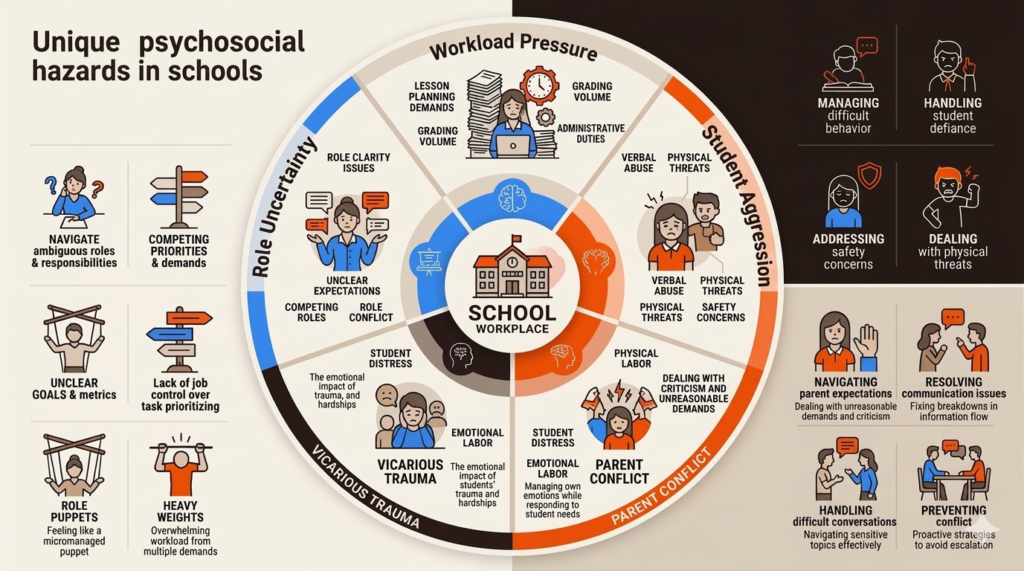
Schools present a unique combination of psychosocial hazards that you won’t find in most other workplaces. What makes these risks so challenging to manage?
Work design factors
The structure of teaching work creates several inherent hazards. Consider these common issues:
- Excessive workload and time pressure – Teachers consistently report unrealistic expectations and insufficient time to complete core responsibilities
- High job demands – The sheer quantity of work, including teaching, reporting, meetings, and extracurricular obligations
- Lack of time to focus on teaching and learning – Administrative burdens crowd out the core educational mission
- Bureaucracy and excessive paperwork – Compliance requirements, data gathering, and documentation without adequate systems support
- Lack of role clarity – Unclear responsibilities, especially for new or changing positions
The Australian Principal Occupational Health, Safety and Wellbeing Survey 2022 found that the top two stressors for school leaders were quantity of work and lack of time to focus on teaching and learning.
Source: Australian Principal OH&S Survey 2022
Interpersonal and environmental factors
Schools are intensely social environments, which creates both rewards and risks. Here’s what the research shows:
- Student aggression or violence – The 2022 Principal Survey found 44% of school leaders reported being subject to physical violence, 11.3 times the general population rate. Over 40% of that violence came from students.
- Difficult interactions with parents/carers – Escalating parent demands, complaints, and occasional aggression
- Workplace bullying and harassment – Including horizontal violence between staff members
- Exposure to traumatic events and vicarious trauma – From student disclosures, mandatory reporting processes, and critical incidents
- Poor workplace relationships – Conflict between colleagues, lack of support from leadership
These hazards don’t exist in isolation. A teacher dealing with a violent student incident may simultaneously face excessive reporting requirements and a lack of administrative support, creating a compounding effect.
Source: IEU Victoria Tasmania – Psychosocial Injuries
The university sector warning
The Australian Universities Census on Staff Wellbeing, released in February 2026 by Adelaide University, provides a sobering preview of what unchecked psychosocial hazards produce:
- More than 80% of university staff reported high or very high levels of emotional exhaustion
- All universities recorded high or very high psychosocial safety risks
- More than three-quarters of staff reported elevated psychosocial safety risk levels
- Psychosocial safety climate risks in universities are more than double those in the general workforce
- 73% disagreed that risks to their psychological health were actively monitored
While universities face different pressures than schools, the underlying dynamics (high workloads, job insecurity, restructures, public scrutiny) have clear parallels. The education sector as a whole is experiencing a psychosocial safety crisis. Is your school prepared?
Source: Newswise – Psychosocial Safety Pressures Across Australian Universities
Duty of care extends to students too
While the new OHS regulations focus on staff, schools’ duty of care has always covered student psychological safety. The two are deeply interconnected. Why does this matter for your risk management approach?
Student psychological safety obligations
Schools must provide safe learning environments, and safety includes emotional, psychological, and cultural dimensions. The Commission for Children and Young People (CCYP) reports that approximately 20% of all allegations involve behaviour causing significant emotional or psychological harm.
Failing to provide a psychologically safe environment can constitute:
- A breach of duty of care
- An allegation of significant neglect
- A reportable allegation under the Reportable Conduct Scheme
- A psychosocial hazard for staff who must manage the consequences
Source: Safe Space Legal – Psychological Safety of Students
What student psychological safety looks like
Psychologically safe learning environments have observable characteristics:
- Students willingly attend school and engage in activities
- Students feel comfortable asking questions and admitting confusion
- Risk-taking in learning is viewed as an opportunity for growth
- Students seek help and feedback from staff without fear
- Problems in the classroom are openly addressed
- Empathy and respect are fostered between peers
- Positive professional relationships exist between staff and students
Research links student psychological safety to reduced bullying, improved behaviour, better academic performance, and increased self-confidence.
The staff-student psychosocial safety connection
Here’s where it gets interesting. Staff wellbeing and student psychological safety are not separate issues. They’re two sides of the same coin.
Stressed, overwhelmed teachers cannot create psychologically safe classrooms. Teachers experiencing vicarious trauma without support may become emotionally distant or reactive. Staff who don’t feel safe speaking up about workload concerns model silence to students.
When schools invest in staff psychological safety, the benefits flow to students. Teachers with adequate support and reasonable workloads have the emotional capacity to build relationships, respond to student needs, and create the conditions for learning.
This is why an integrated approach matters. Schools that treat staff psychosocial safety as merely a compliance exercise miss the bigger picture. The schools that’ll thrive under the new regulations are those that recognise staff and student psychological safety as interdependent priorities.
A practical psychosocial safety framework for implementation
Moving from awareness to action requires a clear plan. The good news is that schools don’t need entirely new systems. Psychosocial safety can be integrated into existing risk management software and WHS processes.

Stage 1: Identify psychosocial hazards
Start with a systematic review of workplace conditions. The Victorian Department of Education has identified common psychosocial hazards and controls to be included in school OHS risk registers, which provides a useful starting point.
Key identification methods include:
- Consulting with staff – Teachers and support staff are best placed to identify pressures and challenges. They know where the pain points are.
- Reviewing existing data – Incident reports, absenteeism patterns, workers compensation claims, and exit interview feedback
- Using structured surveys – Anonymous staff wellbeing surveys can reveal hazards that don’t surface in open forums
- Examining work design – Analysing job descriptions, workload distribution, and organisational structures for inherent hazards
Document all identified hazards in your OHS risk register alongside physical hazards. The Victorian Department provides pre-populated risk registers that include psychosocial hazards, which can accelerate this process.
Source: Victorian Government – Building a Mentally Healthy Workplace
Stage 2: Assess the risks
Not all hazards carry equal risk. Assessment should consider:
- Duration, frequency, and severity of exposure – A one-off traumatic incident carries different risk than chronic excessive workload
- Interaction effects – How hazards combine. High workload plus poor management support is more dangerous than either alone
- Systems of work – How work is managed, organised, and supported
- Workplace interactions and behaviours – The cultural context in which hazards exist
- Existing controls – What’s already in place and how effective it is
Risk assessment should involve consultation with affected staff and Health and Safety Representatives. Their lived experience provides essential context that management might miss.
Stage 3: Implement control measures
The hierarchy of controls applies to psychosocial hazards just as it does to physical ones:
Elimination – Remove the hazard entirely where practicable. This might mean restructuring roles to eliminate excessive workload, or removing staff from situations where violence is predictable and preventable.
Reduction – Where elimination isn’t practicable, reduce exposure:
- Review workload distribution across staff
- Strengthen behaviour management support for challenging students
- Establish clear reporting processes for bullying or aggression
- Provide access to wellbeing support services, including EAP
- Offer training in conflict management and trauma-informed practice
- Implement supervision or debriefing protocols for traumatic exposures
Administrative controls – Policies, procedures, and training that support psychological safety. These should never be the only controls, but they’re essential components.
Stage 4: Monitor, review, and report
Psychosocial risk management is ongoing, not a one-off exercise. Here’s what ongoing management looks like:
- Monitor controls – Regular assessment of whether controls are working. Indicators include staff feedback, incident reports, absenteeism rates, and workers compensation claims.
- Review at least annually – Formal review of the risk register and control effectiveness, more frequently if incidents occur.
- Maintain records – Document hazard identification, risk assessments, control implementations, and review outcomes.
- Report as required – For larger employers in Victoria, half-yearly reports on reportable psychosocial complaints.
Technology’s role in psychosocial risk management
While policies and culture are foundational, technology can streamline compliance and risk management:
- Digital risk registers – Centralised hazard tracking with automated review reminders
- Incident reporting systems – Streamlined reporting, investigation workflows, and corrective action tracking
- Staff survey platforms – Regular pulse checks on workplace climate and emerging hazards
- Integrated WHS systems – Connecting psychosocial risk management with existing safety software and processes
The key is integration. Psychosocial safety shouldn’t exist in a separate silo. It should be part of your overall governance, risk, and compliance framework.
Building a culture beyond compliance
Meeting regulatory requirements is the minimum. The schools that’ll truly benefit from this focus on psychosocial safety are those that use it as a catalyst for cultural transformation.
From psychosocial safety compliance to culture
Checkbox approaches fail because they treat symptoms without addressing root causes. A staff wellbeing program layered on top of toxic workload practices won’t work. Neither will anti-bullying policies in environments where aggressive behaviour is modelled by leadership.
Professor Tony LaMontagne’s three-pronged framework provides a useful structure:
- Protect mental health – Reduce risks through work design and hazard control
- Promote mental health – Develop positive aspects of work and worker capabilities
- Address and support – Respond to mental health issues regardless of cause
All three prongs are necessary. Focusing only on protection creates a deficit mindset. Ignoring protection in favour of promotion leaves hazards unaddressed.
Source: Compassionate Schools – Psychosocial Health and Safety
Practical cultural initiatives
Culture is built through consistent actions over time. Where could you start?
- Regular staff surveys with visible action – Ask for input, then show how feedback drives change
- Mentorship and co-worker support schemes – Peer support networks for challenging roles
- Supervision as safe space – Structured opportunities to discuss difficult cases and experiences
- Flexible working arrangements – Where operational requirements allow, provide genuine flexibility
- Recognition and appreciation practices – Regular, specific acknowledgment of effort and contribution
Amy Edmondson’s research on psychological safety shows that people need to feel safe to speak up, admit mistakes, and take interpersonal risks. In schools, this translates to cultures where teachers can acknowledge when they’re struggling, where asking for help is normalised, and where innovation is encouraged rather than punished.
Governance and board oversight
School boards and councils have governance responsibilities for psychosocial safety that often aren’t recognised. Key questions boards should be asking:
- What psychosocial hazards have been identified in our school?
- What controls are in place, and how do we know they’re effective?
- What does our incident data tell us about emerging risks?
- How are we tracking against regulatory requirements?
- What investment is needed to maintain and improve psychological safety?
Boards should receive regular reports on psychosocial safety metrics alongside financial and academic performance. This is where strategic planning software can help integrate psychosocial safety into broader organisational planning and reporting.
Taking the next step with psychosocial safety
The shift toward mandated psychosocial safety regulation represents a significant change for Australian schools. But it’s a change that creates opportunity alongside obligation.
Schools that proactively address psychosocial hazards will see benefits beyond compliance:
- Reduced staff turnover and associated recruitment costs
- Lower workers compensation premiums and claims
- Improved staff engagement and performance
- Better student outcomes through more stable, supported teaching staff
- Enhanced reputation as an employer of choice
The framework is clear: identify hazards, assess risks, implement controls, monitor and review. The tools exist, from pre-populated risk registers to integrated risk management software. What’s needed now is leadership commitment and systematic implementation.
At Skefto, we work with Australian schools to integrate psychosocial safety into comprehensive governance, risk, and compliance frameworks. Our education industry solutions combine purpose-built software with practical implementation support, helping schools move from compliance to genuine cultural transformation.
If you’re assessing your current state or building your psychosocial safety roadmap, book a demo to discuss how we can support your journey.
Frequently Asked Questions about psychosocial safety
What is psychosocial safety and why does it matter for schools?
Psychosocial safety refers to protection from psychological harm in the workplace. For schools, it matters because educators face unique hazards including high workloads, student violence, exposure to trauma, and vicarious stress. New regulations in Victoria and nationally make psychosocial risk management mandatory, not optional.
Do the new psychosocial safety regulations apply to all Australian schools?
All Australian schools have obligations under Work Health and Safety laws to manage psychosocial hazards. Victoria has introduced specific regulations effective 1 December 2025 that provide detailed requirements. Other states and territories are following similar directions through Safe Work Australia guidance.
What are the most common psychosocial hazards in schools?
Common hazards include excessive workload, high job demands, student aggression or violence, difficult parent interactions, workplace bullying, exposure to traumatic events, lack of role clarity, and poor work-life balance. These often interact, creating compounding effects.
How can schools identify psychosocial hazards in their workplace?
Schools should consult with staff through surveys and meetings, review incident data and absenteeism patterns, examine work design and organisational structures, and use structured risk assessment tools. The Victorian Department of Education provides pre-populated risk registers that include common psychosocial hazards.
What practical steps can school leaders take to improve psychosocial safety?
School leaders should implement the four-stage risk management process: identify hazards, assess risks, implement control measures (eliminate or reduce hazards), and monitor/review effectiveness. Practical steps include workload review, behaviour management support, clear reporting processes, wellbeing services, and trauma-informed training.
Does psychosocial safety only apply to staff, or does it include students too?
While the new OHS regulations focus on staff, schools have always had a duty of care extending to student psychological safety. The two are interconnected: staff wellbeing directly impacts the ability to create psychologically safe learning environments for students. Schools should take an integrated approach addressing both.